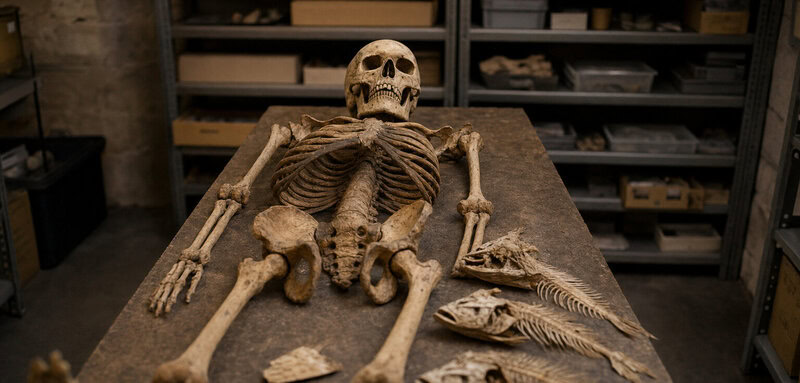
Somewhere in a museum basement, a skeleton is lying about its age — and the culprit is fish. For decades, a quiet flaw in one of archaeology’s most trusted tools has been making ancient bones appear centuries older than they really are, reshuffling historical timelines and casting doubt on thousands of published dates. The mechanism is called the reservoir effect, and it deserves a clearer explanation than it usually gets. Here are nine persistent myths about the problem — and why correcting them matters.
1. Carbon dating is basically infallible once scientists run the numbers
Radiocarbon dating is a genuinely brilliant technique. It measures the steady decay of carbon-14 in organic material and, for land-based organisms eating a terrestrial diet, it works with remarkable consistency. The trouble begins the moment fish enter the equation. Aquatic environments hold carbon that is already depleted in carbon-14 relative to the atmosphere, because deep or slow-moving water recycles old carbon that has long since fallen out of equilibrium with the air above it. When a person spends a lifetime eating fish, that ancient aquatic carbon becomes woven into their bones. The instrument keeps ticking accurately; it is simply measuring the wrong starting point.
The resulting error is not a rounding difference. Researchers from the University of Southern Denmark confirmed that the fish-diet bias is a real, measurable distortion in the radiocarbon record — one that can make a person’s bones appear hundreds of years older than the individual actually was. That is not a footnote. It is enough to place a burial on the wrong side of almost any watershed moment in recorded history.
2. Only freshwater fish interfere with radiocarbon dates — saltwater species are safe
The freshwater reservoir effect has the louder reputation, largely because river and lake water chemistry is especially prone to recycling ancient carbon that has leached from surrounding geology. But the sea is not the neutral, well-mixed carbon pool that this myth assumes. Ocean water also holds old, carbon-14-depleted carbon, and that carbon travels up the marine food chain into fish and then into the bones of the coastal communities who eat them.
Research reported by EurekAlert found that saltwater fish consumption alone could push apparent bone ages 300 to 500 years into the past — a distortion comparable in scale to the freshwater problem. This means that archaeologists working on Viking seafarers, Polynesian voyagers, or Bronze Age coastal traders have all been operating in territory where the supposedly safe marine assumption was quietly leading them astray. Neither freshwater nor saltwater offers a clean escape from the effect.
3. The reservoir effect only skews dates by a few decades at most
A few decades of error might be inconvenient but survivable — historians and archaeologists routinely work within margins of uncertainty. A shift of several centuries is an entirely different category of problem. The reservoir effect can do precisely that: move an apparent date by hundreds of years, not tens.
A 300-to-500-year displacement is enough to place a burial on the wrong side of almost any watershed moment in history — before or after the Viking incursions into Britain, before or after the Norman Conquest, before or after the Black Death. And because the scale of the error tracks how fish-heavy an individual’s diet actually was, two skeletons buried side by side could yield dramatically different radiocarbon dates if one person was an inland farmer and the other spent every day hauling nets from a nearby river. The bones look identical. The dates tell wildly different stories.
4. The dating error is consistent and predictable regardless of where the bones come from
If the reservoir effect produced a reliable, universal skew — say, always exactly 400 years — archaeologists could simply subtract that number and move on. The reality is messier. The magnitude of the distortion varies by region because different lakes, rivers, and seas have different water chemistry, different rates of carbon exchange with the atmosphere, and different fish species each carrying their own isotope signature.
A coastal Scandinavian community eating cold-water North Sea fish faces a different calibration challenge than an inland central European population relying on river carp or pike, which in turn differs from a community fishing the Nile or the North American Great Lakes. The geographic variability means there is no single correction factor that archaeologists can plug into their calculations. Each site, and potentially each individual within a site, may require its own bespoke adjustment derived from local environmental data.
5. Dating the objects buried with a skeleton gives you the same date as dating the skeleton itself
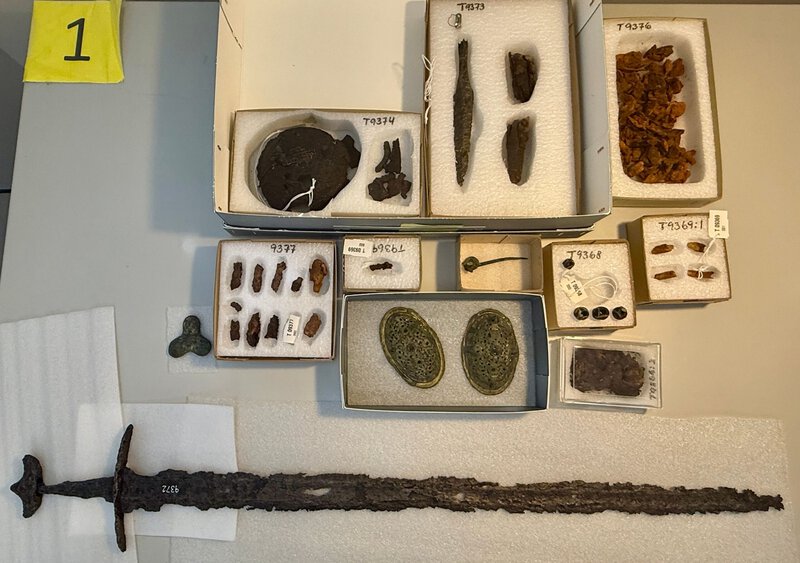
Grave goods — swords, brooches, pottery, charcoal from a funeral pyre — absorb their carbon from the atmosphere or from land-based organic materials and are therefore untouched by the aquatic reservoir effect. They date cleanly. The skeleton lying among them, if it belonged to a dedicated fish-eater, may not.
This creates one of the most disorienting scenarios in archaeological science: the buried sword correctly dates to AD 900, while the warrior’s own bones clock in at AD 600, a three-century gap generated entirely by a lifetime of fish suppers. The human skeleton, rather than the objects surrounding it, becomes the specific target of the dietary bias. In a cruel irony, the person’s own body becomes the least reliable witness to the era in which they lived, while the inanimate iron blade beside them tells a truer story.
6. Scientists can always tell from the bones themselves how much fish someone ate
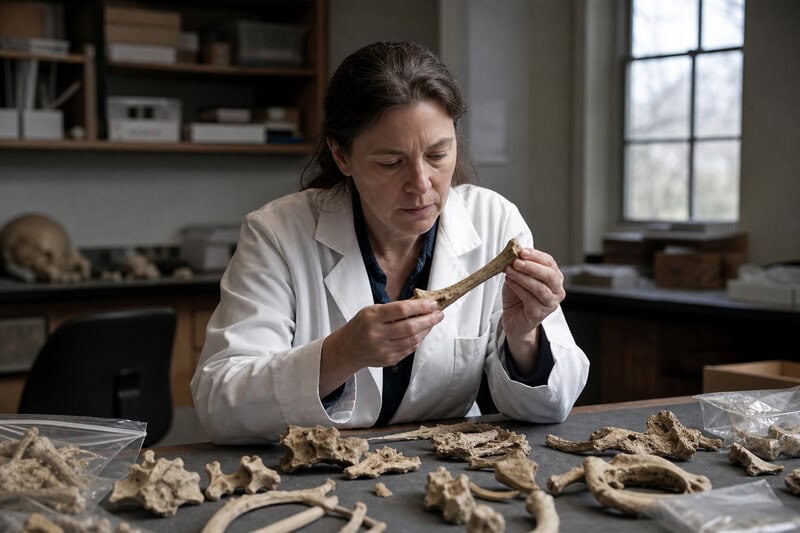
There is no visible marker in a bone that announces a fish-heavy diet. No discolouration, no structural difference, no sign legible to the naked eye or even standard laboratory examination that the radiocarbon date needs adjusting. The distortion is completely invisible without specialist isotope analysis running alongside the standard radiocarbon test — specifically, a stable-isotope dietary study measuring ratios of carbon-13 and nitrogen-15, which can reveal the broad outlines of what a person regularly consumed over their lifetime.
Without that additional analysis, researchers may apply a radiocarbon date in good faith, with no idea that a fish-diet correction was ever needed. This is precisely why a large body of previously published dates on coastal and riverine populations is now under active scrutiny: many of those original studies were conducted before the full scale of the reservoir effect on human bone was understood, and the methodological gap was never flagged in the published record. The error propagated silently through the literature.
7. The problem only matters for populations that relied heavily on fish as a dietary staple

It is tempting to draw a clean line: subsistence fishermen on one side, land-based farmers on the other. But even moderate, non-staple fish consumption can introduce measurable distortion. The effect scales with intake, but a small amount of fish is not necessarily a safe threshold below which dates can be trusted without question. The assumption that a population was essentially land-based simply because it does not appear in the written record as a fishing community has itself become part of the problem.
Medieval European peasants, for instance, frequently supplemented their diet with river fish, eels, or preserved saltfish in ways that left no trace in documents but left a clear chemical signature in their bones. Because the error compounds with consumption, an individual who ate fish only occasionally might show a modest skew, while a neighbour who fished professionally could appear — through radiocarbon dating alone — to belong to a completely different century. The boundary between “affected” and “unaffected” is far less clear than the myth implies.
8. This is a newly discovered glitch that only recent archaeology has had to worry about
The reservoir effect has been known in principle since the mid-twentieth century. It is not a shock finding from last year’s field season. What took decades longer to establish was its full impact on individual human skeletons specifically, as distinct from shells, fish bones, or aquatic plant material where the effect had been more readily recognised. The evidence accumulated slowly, study by study, and the broader reckoning for human remains came later still.
Crucially, thousands of radiocarbon dates on human remains were published and entered the permanent scholarly record before researchers fully grasped how dramatically fish-eating could distort the results. The University of Southern Denmark research is part of an ongoing, worldwide effort to revisit and potentially redate skeletal collections — a quiet revolution running beneath the surface of published archaeological chronologies, correcting the record one skeleton at a time. The age of those earlier dates is itself part of what makes them difficult to fix.
9. Correcting for the reservoir effect is straightforward once you know fish were part of the diet
Knowing that a population ate fish is only the first step, and in practice it may turn out to be the easiest one. To calculate a meaningful correction, scientists also need to know what species were eaten, from what body of water, and with what local carbon chemistry — details that are rarely preserved anywhere in the archaeological record. A correction calculated for North Sea herring cannot simply be borrowed and applied to Baltic pike or Nile perch, because the carbon-isotope signature of the source water differs substantially in each case.
In many situations the correction remains approximate at best, leaving a date expressed as a range of uncertainty rather than a confident single figure. That is an honest and defensible outcome — arguably more trustworthy than false precision — but it is a humbling admission for a technique that was once presented to the public as something close to exact. The fish, it turns out, have been muddying the waters all along.
The constructive side of this story is that awareness of the problem is now driving measurably better science. Stable-isotope dietary analysis is increasingly paired with radiocarbon dating as standard practice on human remains, old dates are being revisited with fresh methodological eyes, and site reports are more likely than ever to flag the dietary context of the individuals being dated. The bones are still talking. Archaeologists are simply learning, at last, to ask them the right follow-up questions.