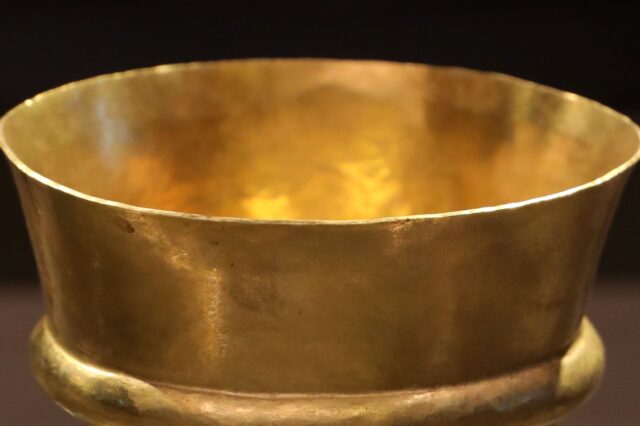
When archaeologists unsealed a wooden cupboard in Pompeii’s House of Cornelius Maximus, they found something rarer than gold: an ordinary morning, preserved for nearly two thousand years. The discovery has already attracted a tangle of assumptions — about Roman women, their beauty habits, and what this particular find actually means. Nine of the most persistent misconceptions deserve a direct answer.
The wardrobe was a working storage chest, not a decorative piece of furniture
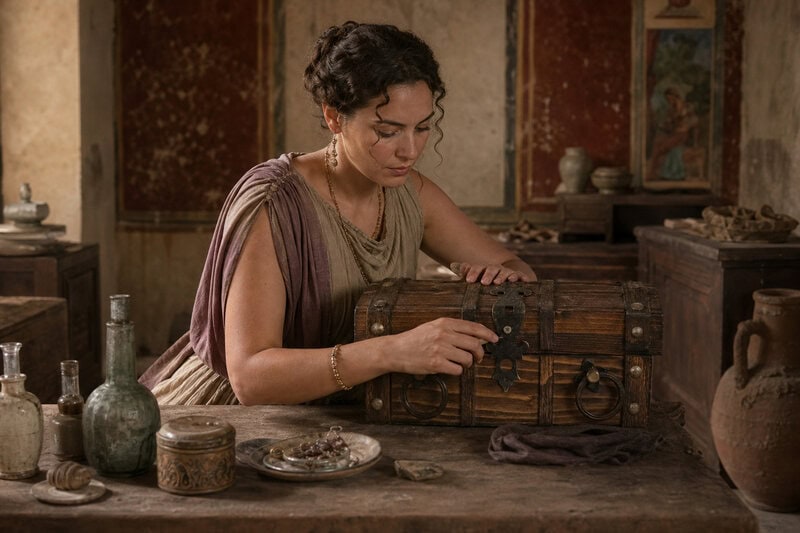
The wooden cupboard recovered from the House of Cornelius Maximus was no showpiece. It was a working chest, stuffed with the material reality of one woman’s life — cosmetic tools, jewelry, coins, glassware — sealed shut on the morning Vesuvius erupted in 79 CE and never opened again. That accidental sealing is what makes it so extraordinary: nearly two millennia passed without a single object being moved, stolen, or tidied away by a well-meaning hand.
In archaeology, context is almost everything. The fact that nothing was disturbed means researchers can read the spatial relationships between objects exactly as that woman left them, reconstructing not just what she owned but how she lived. It stands as one of the most intact domestic assemblages ever recovered from Pompeii — not a curated display, but a life caught mid-sentence.
Roman women used purpose-made, specialized cosmetic tools
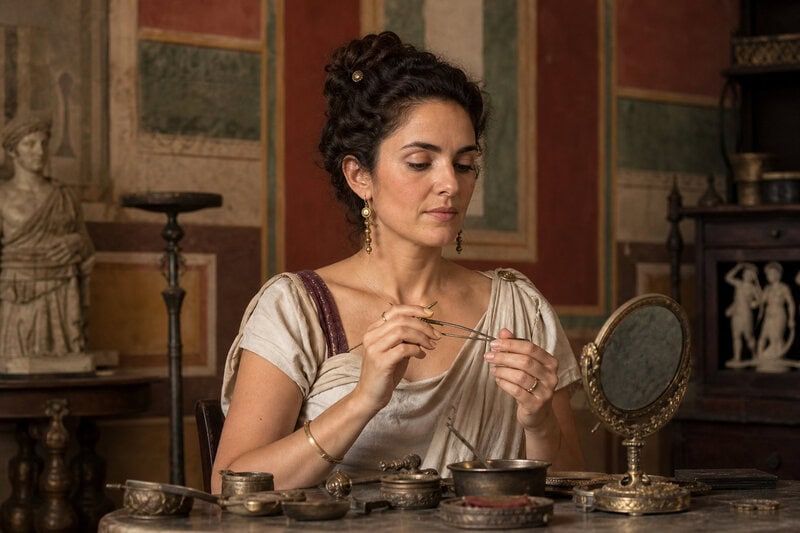
Open the wardrobe’s inventory and two objects immediately challenge the idea of Roman beauty as improvised or rough: a pair of tweezers and a small spatula designed for mixing pigments. These are not general-purpose household implements. They map almost perfectly onto tools found in a modern makeup bag — one for hair removal, one for blending product — and their presence confirms that cosmetic application in a Roman household was a deliberate, multi-step process.
Roman women used those spatulas to work with substances including lead-based white foundation for skin tone, red ochre for cheeks and lips, and kohl-like compounds to define the eyes. That these tools turned up inside a personal wardrobe rather than a public bathhouse or a professional setting tells us something important: this was a private, daily domestic ritual, as unremarkable and as essential as brushing one’s teeth.
Perfume was a routine personal item for Roman women across social classes, not a male luxury
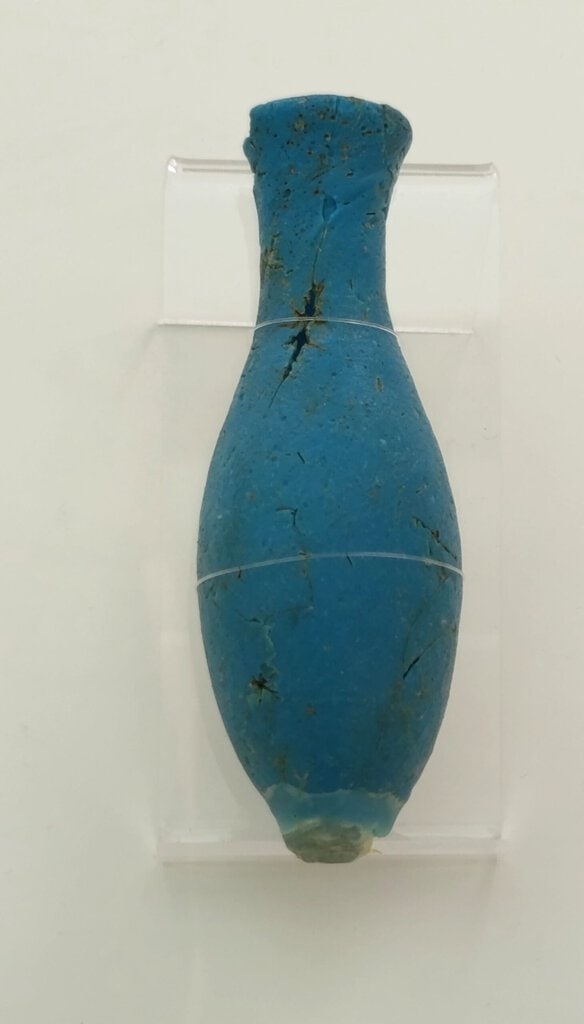
Tucked among the grooming tools was a glass balsamarium — a small, purpose-made bottle for holding perfumed oil or ointment. The vessel is elegant but not exceptional; balsamaria were common personal possessions for Roman women across a wide range of social classes, not rarities locked away in aristocratic treasuries. Finding one here, alongside everyday items, places fragrance firmly in the category of routine rather than extravagance.
The better comparison is not a perfume counter at a luxury department store but a small bottle of scented lotion sitting on a bathroom shelf. For the woman who owned this chest, fragrance was simply part of getting ready — as habitual and unspecial as the tweezers beside it.
The jewelry carried religious and biographical meaning, not merely decorative value
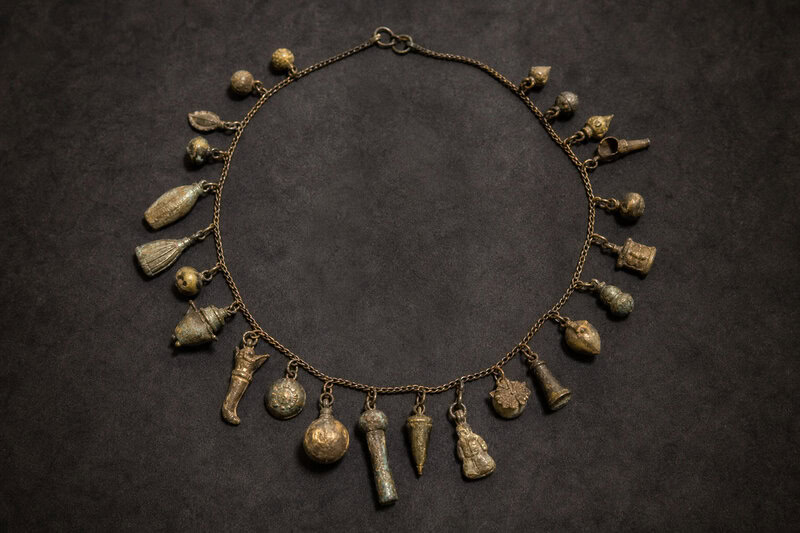
The necklace recovered from the wardrobe carries 24 individual charms and has been described by archaeologists not as adornment but as a protective necklace — apotropaic in purpose, meant to deflect evil rather than simply to beautify. It has been identified as a childhood charm necklace, the kind Roman children wore as a matter of course, though adults sometimes kept them well into later life as talismans or objects dense with personal memory.
That distinction collapses the tidy modern boundary between jewelry, religion, and biography. For its owner, the piece was all three things at once: something worn against harm, something tied to childhood, and something beautiful enough to keep. It was not decorating her body so much as it was protecting her history.
Cosmetics, valuables, and currency were stored together — and that tells us something important
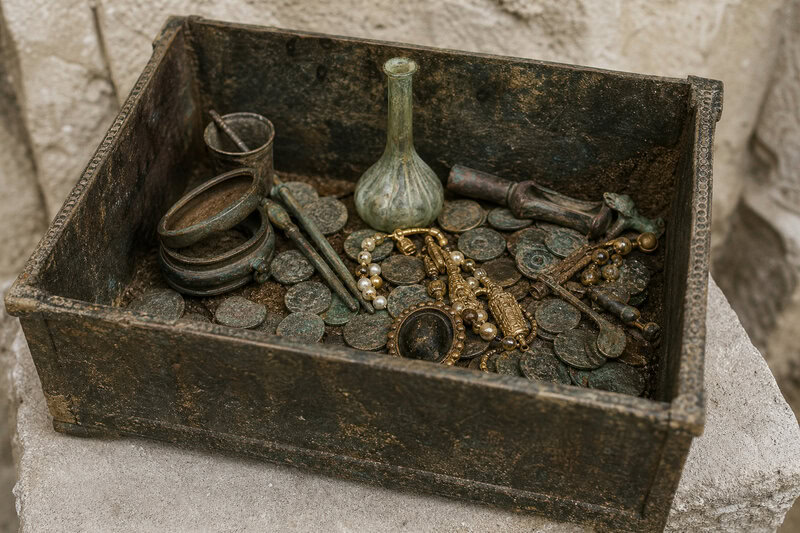
The wardrobe held beauty tools, a perfume bottle, jewelry, and 38 bronze coins — all in the same chest, with no apparent effort to keep the cosmetic items apart from the currency or the ornaments apart from either. The co-mingling is not accidental disorder; it suggests the chest functioned simultaneously as a vanity case and a personal strongbox, housing everything its owner considered most important and most portable in one place.
The organizational logic is strikingly familiar. Many people today keep cash, jewelry, and personal care items in the same nightstand drawer, not out of carelessness but because these are the things that belong close to hand and close to the self. Across two thousand years, that instinct appears to have changed very little.
This discovery is not just another silver hoard — its significance is intimate, not monetary
As many as 118 pieces of silverware were associated with the broader discovery at the House of Cornelius Maximus, and it would be easy to file this find under the familiar heading of “Pompeii silver hoard.” But that framing misses what is actually unusual here. The wardrobe’s significance lies in its intimate, personal character — the spatula still faintly functional, the tweezers still serviceable, the charm necklace still weighted with its 24 pendants — not in the silver.
A typical Pompeii silver hoard tells the story of a family grabbing valuables before fleeing a disaster. This wardrobe tells a different story: a life already in progress, with objects in active daily use when the mountain ended everything. The collision of mundane grooming tools and precious silverware in the same sealed context is what collapses the distance between the extraordinary and the ordinary, and between that morning and this one.
Pompeii still holds pristine, undisturbed deposits — this wardrobe proves it

Pompeii has been dug, raided, and re-excavated in overlapping waves since the eighteenth century. It is a reasonable assumption that anything worth finding has long since been found — or taken. The wardrobe in the House of Cornelius Maximus disproves that assumption directly: it sat undisturbed for nearly two thousand years, a sealed deposit that earlier excavators simply never reached or recognized.
Systematic, methodical modern excavation continues to uncover pristine deposits across the site, precisely because the earlier work was uneven and the city is enormous. A sealed context like this one is irreplaceable — not just for what it contains, but for the spatial information it preserves intact. Once a site is looted or disturbed, those relationships between objects are gone permanently, and no amount of recovered silver can restore them.
Roman beauty practices were sophisticated, deliberate, and methodical — not crude
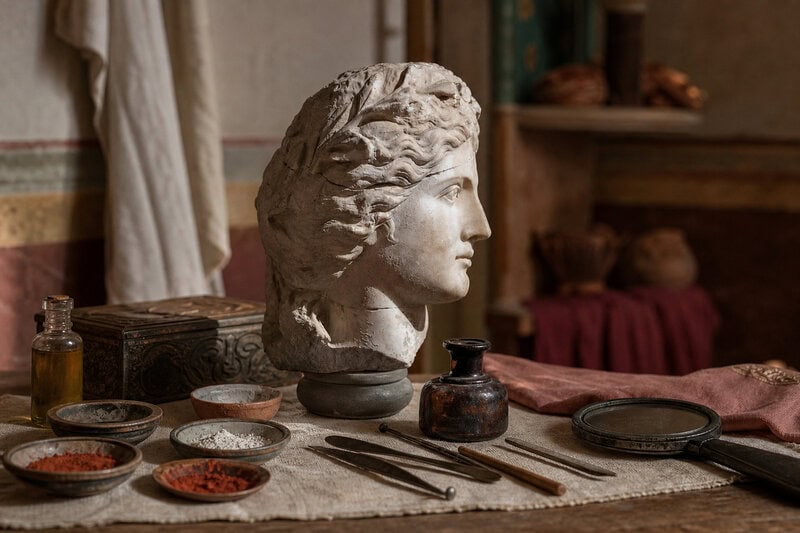
The toolkit inside the wardrobe — a spatula for blending pigments, tweezers for hair removal, a dedicated perfume vessel — describes a beauty regimen that any modern person would recognize immediately. Roman women worked with formulated cosmetics: white lead or chalk to even skin tone, red ochre or wine dregs for lips and cheeks, antimony or fine soot to define the eyes. These were not random pigments dabbed on without thought but deliberately prepared, blended products applied with purpose-made tools.
What the wardrobe provides, crucially, is a physical anchor for descriptions of Roman beauty practices that previously existed mainly in written sources — often recorded by male satirists who mocked rather than documented. These were real tools held in real hands, in one specific household, on one specific morning in 79 CE. The routine was not crude; it was simply ancient, which is not the same thing.
The wardrobe’s contents suggest a woman of middling means, not an aristocratic elite
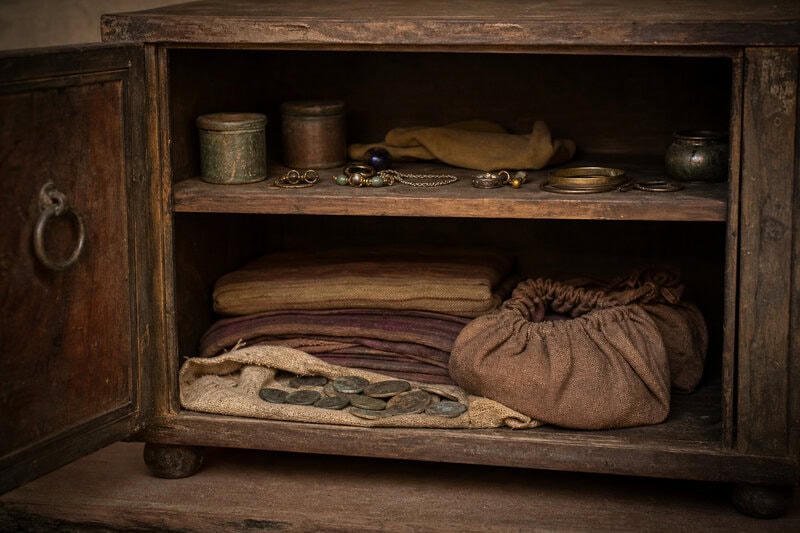
The name Cornelius Maximus carries a certain Roman grandeur, and it is tempting to imagine the house as a vast, marble-cool aristocratic residence wholly unlike ordinary domestic life. But the wardrobe’s contents push back against that image. The 38 bronze coins found inside represent a modest sum — not the savings of Pompeii’s super-wealthy but the carefully kept small reserves of someone of middling means. The charm necklace is not a showpiece of costly gems but a childhood keepsake held onto for reasons that had nothing to do with display.
What emerges is something more human and more interesting than a treasure vault: a personal room in a busy household, belonging to a woman whose daily concerns — how she looked, what might harm her, how much she had saved — were not so different from concerns held by millions of people today. The find brings her daily life into focus not because it is spectacular but because it is specific, and specificity is where history stops being a subject and starts being a person.
The sealed wardrobe from the House of Cornelius Maximus is, in the end, a corrective — to assumptions about Roman women’s sophistication, about what Pompeii still holds, and about how much distance actually separates us from a woman who mixed her pigments, tucked her coins away, and kept a necklace from childhood close at hand on the last ordinary morning of her world.