The wardrobe had been closed for 1,946 years. When archaeologists finally eased it open in the House of Cornelius Maximus in Pompeii, the hands reaching inside were the first to touch its contents since a woman placed them there on an ordinary August morning in 79 CE — before the mountain ended her morning, and everything else.
The Wardrobe Nobody Opened for Nearly Two Thousand Years
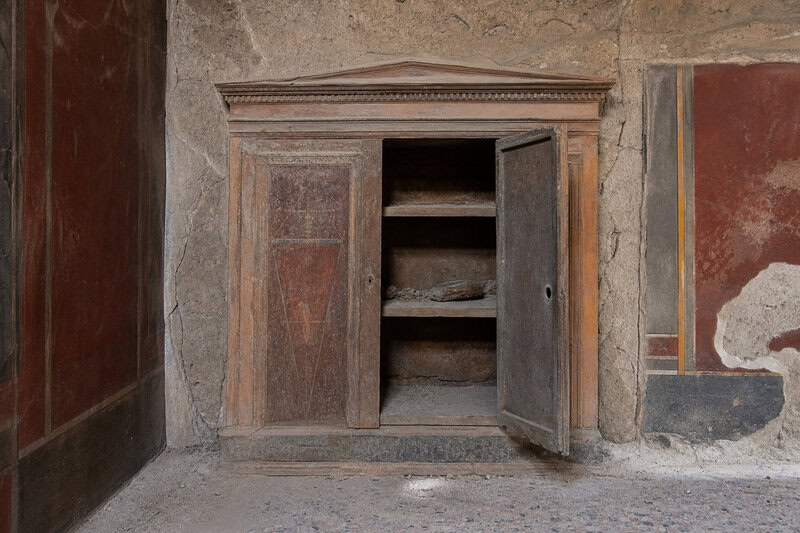
This is not a tomb. It is not a temple treasury or a general’s strongbox. It is a wardrobe — the kind of furniture so mundane that its owner would have opened and closed it a dozen times a week without thinking, the way anyone reaches for a coat or checks that their purse is where they left it. That is precisely what makes the Pompeii wardrobe found sealed since 79 CE so extraordinary: it was not preserved because it was important. It was preserved because the volcano arrived before the woman who owned it could come back for her things.
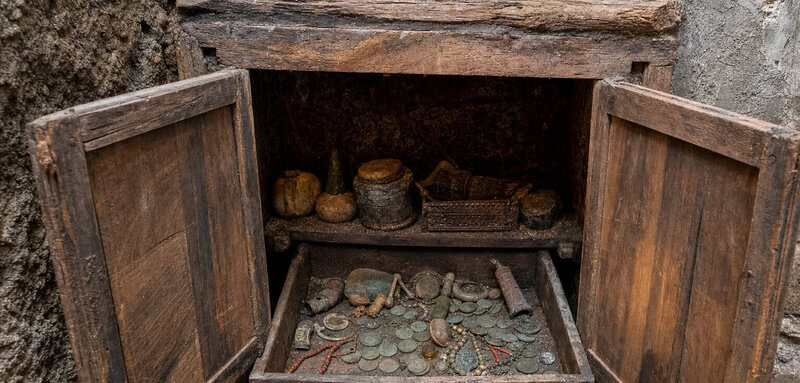
Archaeologists working at the Parco Archeologico di Pompei — an institution that has been rewriting the granular detail of daily Roman life with almost unfair regularity in recent years — uncovered the outline of the wooden wardrobe in the House of Cornelius Maximus. The wood itself had largely surrendered to time, as wood does. But the ash and pumice that sealed the structure created something close to a preserving darkness that kept the wardrobe’s contents in nearly the same arrangement in which their owner had left them. Inside: tweezers, a glass perfume bottle, cosmetics, lead weights, 38 bronze coins nestled in a small woven basket, and a necklace strung with at least 24 tiny charms.
History never recorded this woman’s name. She left no inscription on the walls of the house, no graffiti scratched into the plaster of a Pompeian street, no will that survived the eruption. But she left her wardrobe. And it turns out that is more than enough to begin to know her.
A House, a Name, and the Woman History Forgot
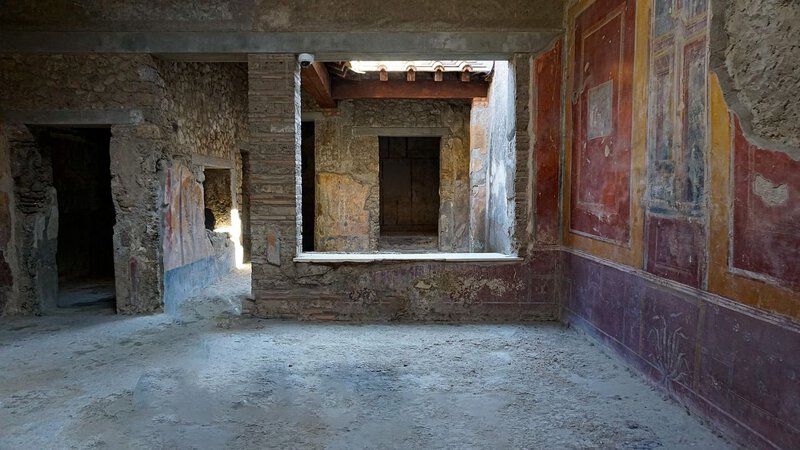
The House of Cornelius Maximus gives her an address, and the man whose name it bears gives the address a face — but only just. The property’s owner is known by inscription, the standard Roman way of staking a claim on a building for posterity. The woman whose belongings survived inside it did not rate an inscription. This was not unusual. Roman domestic life, as documented by Roman men writing for Roman men, had a pronounced tendency to leave women in the margins.
Pompeii in the summer of 79 CE was a city of roughly 11,000 people: prosperous, cosmopolitan, smelling of bread from its many bakeries and garum from its fish-sauce workshops, its walls covered in election notices and declarations of love and the occasional piece of graffiti that would make a classicist blush. It was a port city on the Bay of Naples with money moving through it, and a wardrobe full of coins and cosmetics and personal effects was, in that world, entirely unremarkable. Which is precisely what makes it so rare now. What archaeologists described as bringing to life the daily lives of Pompeii’s women before Vesuvius was, for her, simply Tuesday.
The contents of the wardrobe map onto a woman of middling or comfortable means — not wealthy enough to commission a portrait mosaic, not poor enough to be without a glass perfume vessel. She managed her own small treasury, kept her own grooming kit, tended her own private sentimentalities. Life in Pompeii before the eruption is known largely through frescoes, graffiti, and shop ledgers: public-facing evidence, records of transactions and performances and social display. A sealed wardrobe containing an organic woven basket that had no right to survive two millennia is a different category of evidence entirely. It is private. It is hers.
Thirty-Eight Coins in a Woven Basket
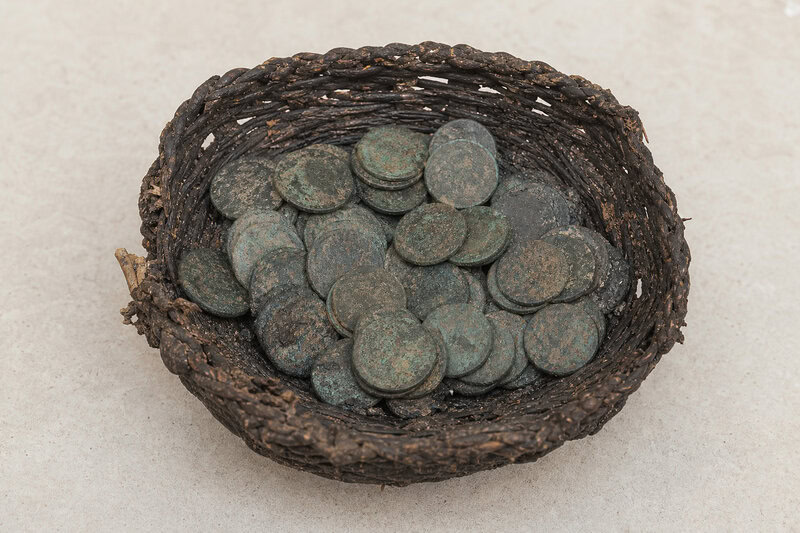
Of all the details in this find, the one that stops you is the basket. Not a purse. Not a chest with a clasp. A small woven basket — the kind of everyday container that archaeology almost never preserves, because organic material and two millennia do not generally coexist. That this one survived, cradling its 38 bronze coins inside a sealed wooden wardrobe inside a city buried under volcanic debris, is the sort of fact that makes archaeologists pause and take photographs before they touch anything.
The coins themselves are bronze, which places them at the workaday end of the Roman monetary spectrum. These were not gold aurei tucked away by a woman of senatorial rank. Bronze coins were the currency of market stalls, bakeries, and thermopolia — the fast-food counters of the Roman world — the denomination you handed over for a loaf or a cup of wine. Thirty-eight of them represent pocket money, not a fortune. The detail that sharpens this into something human is the basket: she had sorted and stored her coins deliberately, the way anyone might set aside exact change before a trip to the forum, confident she would need them again by afternoon.
She did not, of course, need them again. But the coins remained in their basket, and the basket remained in the wardrobe, because the ash-and-pumice seal that killed her city also cheated decay on her behalf — a grim sort of service rendered to posterity.
The Necklace She Kept from Childhood

The necklace is the piece that lingers. Archaeologists identified it as a childhood charm necklace — a bulla-adjacent piece of the sort that Roman girls wore for protection, each small charm a pendant against harm, against illness, against the general hostility of a world that offered children uncertain odds. Girls wore such necklaces, and then they grew up, and the necklaces were often set aside: kept rather than worn, folded into a drawer or a box where they accumulated the particular gravity of things we cannot quite bear to give away.
This one had at least 24 individual charms on a single strand — an oddly specific number that implies accumulation over years, possibly gifts added at festivals or birthdays, each tiny amulet a data point in a life we cannot otherwise read. Twenty-four charms is not a necklace you receive all at once. It is a necklace that grew with you.
That she stored it rather than wore it tells us something. By 79 CE, this was not her daily jewelry. It was her keepsake. The fact that it remained in her wardrobe rather than being passed to a daughter or a niece suggests either that she had no one obvious to pass it to, or — more simply, more humanly — that she was not ready to let it go. Archaeologists working the Pompeii new excavation program deal in objects constantly, but objects that speak this directly to ambivalence, to the small emotional arithmetic of keeping rather than giving, are rarer than coins.
Tweezers, Perfume, and the Grammar of a Roman Woman’s Grooming Kit
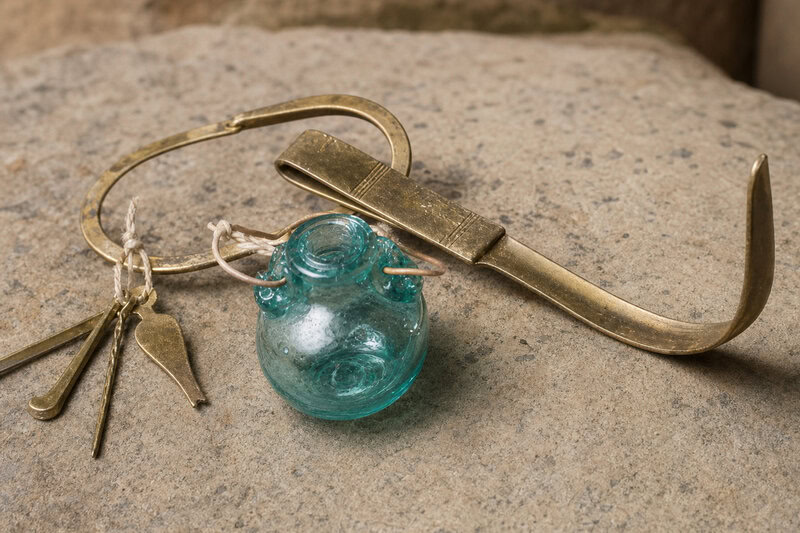
The tweezers and glass perfume bottle place the wardrobe squarely within a tradition well-documented across the Roman empire: the toilet kit, a set of grooming instruments that appears in households from Britain to Egypt, the Roman equivalent of a bathroom cabinet. Finding them among Pompeii artifacts is not surprising. Finding them in this particular intimate assemblage, alongside sentimental keepsakes and pocket change, is what transforms them from typological examples into personal effects.
The glass perfume bottle deserves a moment of attention. Roman glassblowing had, within the century before Vesuvius erupted, made glass vessels affordable to the middle class — a genuine technological democratization, the kind of thing that tends to go unnoticed by contemporaries and unappreciated by historians until someone pulls a bottle out of a wardrobe. It was still handled carefully, still stored rather than left out on a shelf. She kept hers with her other valuables, which is to say she understood it as a modest luxury, which is exactly what it was.
Cosmetics round out the picture in ways that connect her to a beauty culture documented in everything from Ovid’s wry verse to the fresco portraits that line Pompeii’s wealthier walls. Lead-based preparations, kohl, and rouge were standard in elite and middle-class Roman women’s routines, applied with the kind of careful daily attention that Roman male writers alternately praised and satirized, apparently incapable of simply leaving the subject alone.
Then there are the lead weights. They are the most puzzling element of the collection, sitting slightly at odds with the rest of the wardrobe’s logic. Possibly used for weighing ingredients, possibly for small-scale trade — their presence alongside personal cosmetics suggests the wardrobe may have doubled as a working store as well as a keepsake chest. She was, it appears, a practical woman. The necklace she kept for feeling; the weights she kept for use.
What She Left Behind Tells Us How She Lived
Pull back far enough and the significance of this find comes into focus. Most Pompeian finds are architectural — walls, floors, frescoes — or epigraphic, recording public life in public language. Funerary evidence tells us how Romans performed death. What it rarely tells us is how they lived on an ordinary Wednesday: what a woman kept in her wardrobe, how she organized the private material of her existence.
Written Roman sources, almost entirely authored by elite men writing for elite male audiences, had a systematic tendency to describe what women were supposed to keep and value rather than what they actually did. A sealed wardrobe containing a coherent assemblage of one person’s effects offers something that literature cannot: not the prescription, but the practice. Not what Romans said women kept, but what one woman actually kept.
The mix is the thing. Sentimental objects alongside practical ones, luxury items alongside everyday coinage, a childhood keepsake alongside grooming tools — this is the triangulation that fills gaps in the historical record. She was not an archetype. She was a person with a specific arrangement of things that mattered to her in specific ways, and the mountain that killed her also sealed the room that held them. Nearly two thousand years later, we are reading her wardrobe like a letter she never meant to send.
She was not preparing for catastrophe. The wardrobe was closed, not barricaded. She had not stuffed valuables into a sack to carry out of the city. She had left the way anyone leaves a room they plan to return to before dark.
Why Pompeii Still Has Secrets to Give
The Parco Archeologico di Pompei’s systematic re-excavation program — which has been revisiting previously dug zones and opening genuinely unexcavated areas with methodical intensity since the late 2010s — has produced a run of landmark finds that would be remarkable for any single decade of archaeology anywhere in the world: a sealed wardrobe, a fresco of a pregnant woman, a ceremonial room whose walls still hold their color, a fast-food counter with the remnants of its last meal. Pompeii, it turns out, was not finished talking.
Roughly a third of the city has never been fully excavated. That means the ground beneath it still holds wardrobes and kitchens and locked rooms that no living person has entered since 79 CE — an archaeological fact that, if you sit with it for a moment, is almost vertiginous in its implications. There are objects down there right now, in the dark, waiting to rewrite what we know about women’s lives in the ancient Roman world.
The unnamed woman of the House of Cornelius Maximus left no inscription. No will. No graffiti scratched into a wall that might have given us her name or her opinion of the neighbors. She left 38 bronze coins in a woven basket, a glass bottle that once held something that smelled beautiful, a pair of tweezers, some lead weights whose purpose she understood better than we do, cosmetics she applied each morning with the unconscious expertise of habit, and a necklace of at least 24 charms that she had carried with her out of childhood and was not quite ready to put down.
It turns out that is more than enough. A wardrobe, closed for nearly two thousand years, opened at last — and inside it, tucked carefully away against a morning she never came back to, a life.