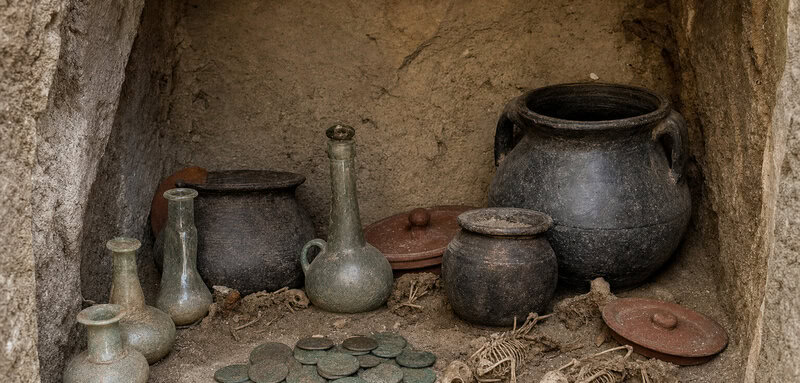
The closet had been sealed for nearly two thousand years when excavators finally opened it — and inside, perfectly undisturbed, sat a Roman woman’s perfume bottles, a household’s cooking pots, thirty-eight bronze coins, and the delicate, articulated skeletons of mice who had, in the end, outlasted every human being in the building.
A World Stopped Mid-Morning on the Via dell’Abbondanza
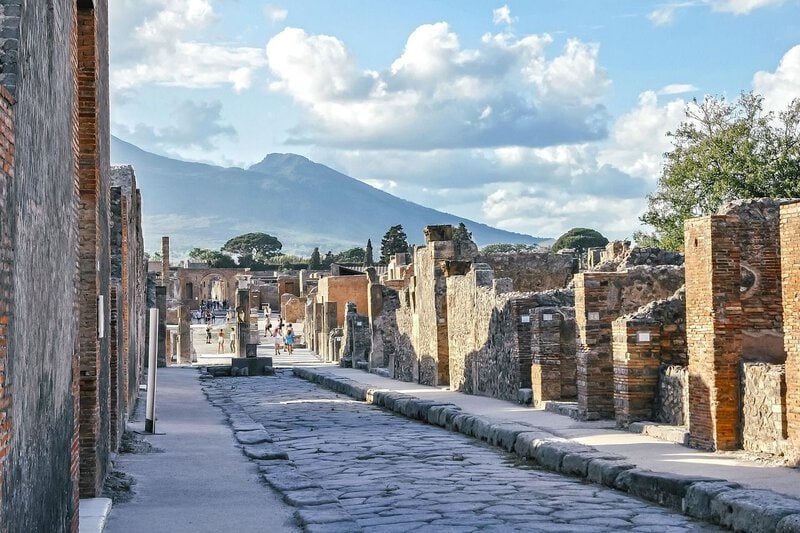
The house stood on the Via dell’Abbondanza, Pompeii’s main commercial artery — a street so alive with foot traffic, street vendors, and election graffiti painted directly onto the plaster that a modern visitor might almost hear the noise still baked into its stones. Thermopolia, the ancient world’s equivalent of fast-food counters, lined the pavement. Workshops clattered. The forum anchored one end of the street; the eastern gate opened at the other. This was not a quiet residential backstreet. Whoever she was, the mistress of the house had a main-street address, and everything that came with it: visibility, commerce, and the constant low-level chaos of a city in motion.
That busy world outside makes the silence inside the closet all the more arresting. According to CBS News, archaeologists found a family’s whole life frozen in time — perfume, cooking pots, those thirty-eight bronze coins — none of it touched since the eruption of Vesuvius, which would bury the city under metres of ash and pumice. The closet had functioned, entirely by accident, as a time capsule of one household’s most ordinary Tuesday.
Pompeii in that final summer held somewhere between eleven thousand and twenty thousand inhabitants, in a city still partly under reconstruction from a catastrophic earthquake seventeen years earlier in 62 CE. Scaffolding stood alongside fresh plaster throughout entire neighbourhoods. The mistress of the house had lived through that earthquake, or had grown up hearing about it. A household on a busy street, in a city already once shaken to its foundations, had learned to keep valuables close. The sealed closet is the proof of that lesson.
What She Kept: Perfume, Pots, and the Logic of the Cache
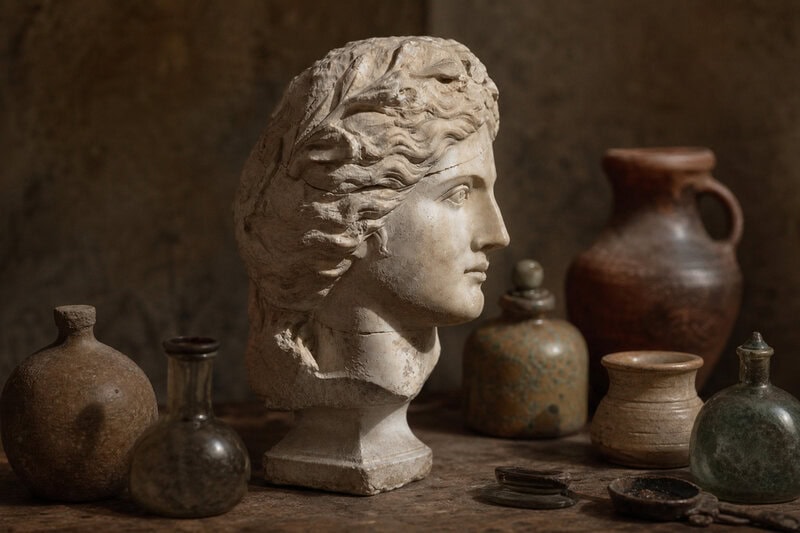
Begin with the cosmetics, because they are the most personal things in the room. Among the finds were ancient perfume containers — small, portable, the kind of object a Roman woman of modest means would guard carefully. Scent ingredients were not cheap: resins came from Arabia, flowers from Egypt, and the finished product passed through multiple hands and considerable distance before arriving in a bottle on a shelf on the Via dell’Abbondanza. Keeping them in the secure closet rather than on a dressing table was not vanity — it was economics.
Roman beauty culture was sophisticated and socially wide-ranging. Cosmetics found at Pompeii and across the empire include lead-based face powder, rouge derived from plant extracts or crushed minerals, and kohl-like preparations for the eyes — items that required knowledge, daily routine, and somewhere specific to store them. Male satirists like Ovid and Juvenal made a favourite sport of deriding excessive makeup, which is actually useful historical evidence: you do not bother satirising a practice that is rare or purely aristocratic. The mistress of the house, applying her preparations each morning before the street outside came fully to life, was doing something utterly unremarkable by the standards of her city.
What is striking is the combination of objects in the closet. Perfume bottles alongside cooking pots suggests this was the household’s general secure storage — not a dedicated vanity room, not a kitchen, but the place where everything genuinely worth protecting ended up together. She had folded her personal grooming supplies into the family’s broader cache of things that mattered. The hierarchy of value implied by that arrangement is immediately legible, across twenty centuries of distance.
Thirty-Eight Bronze Coins and One Haunting Detail
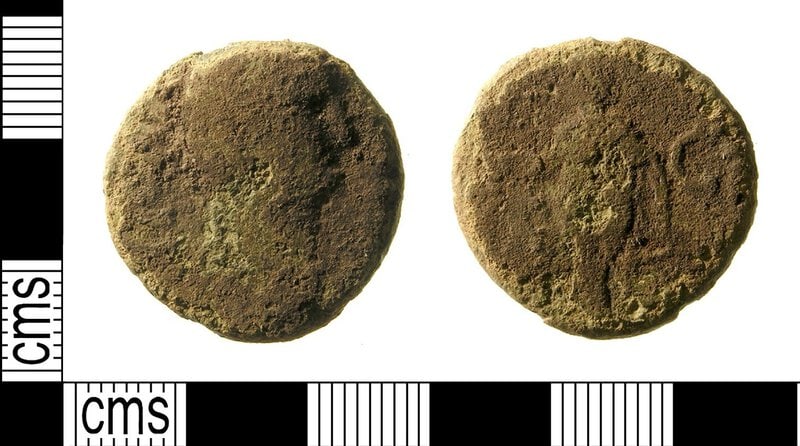
The thirty-eight bronze coins are the find’s most legible economic document. Bronze denominations — asses and sestertii — were working-class currency, the money used for a loaf of bread, entry to the public baths, a cup of cheap wine at one of the thermopolia just outside the front door. This was not a nobleman’s treasury. It was a household’s liquid savings: real purchasing power, carefully accumulated, kept where the family could reach it.
And then they could not reach it. The coins being left behind is the detail that haunts the whole discovery. The family may have escaped the eruption of Vesuvius and simply been unable to return to retrieve their belongings — or they may have died in the chaos before they ever had the chance. Either way, thirty-eight coins sat in that closet through every subsequent century, through the medieval period, through the Renaissance, through the birth of modern archaeology, waiting. Roman coins found at Pompeii across many excavations have helped historians reconstruct inflation, trade networks, and the spending habits of ordinary people. These thirty-eight add one more household’s financial fingerprint to that record — the specific, modest savings of a specific woman on a specific street.
The Uninvited Guests: Mouse Skeletons in the Pantry

Then there are the mice. The mouse skeletons are, it must be said, the detail that makes archaeologists smile and general readers stop scrolling — which is not a reason to dismiss them, because they are also genuinely informative. House mice were a constant, unglamorous feature of Roman domestic life. Ancient authors complained about them raiding grain stores with the weary regularity of people who had given up expecting anything different. Roman households deployed weasels and small snakes as pest control long before cats became the preferred solution.
The mice found their way into the sealed closet almost certainly drawn by food stores — grain, dried goods, whatever organic material was kept alongside the cooking pots. The pyroclastic event that killed the city preserved their small bones as perfectly as it preserved the coins and the perfume bottles. Their skeletons offer unplanned biological data: organic material was definitely present in this closet, confirming it functioned as a true pantry-and-valuables room combined, not merely a secure cupboard for precious objects.
There is something quietly moving about the whole arrangement. The mistress of the house almost certainly fought a running battle with mice in that pantry throughout her time in the building — a battle as old as grain storage itself, and as unwinnable. In the end, the mice and her perfume bottles were preserved together in the same sealed space, equal survivors of the same catastrophe. History is not always dignified, and neither, it turns out, is archaeology.
Escape, or Death? The Question the Closet Cannot Answer
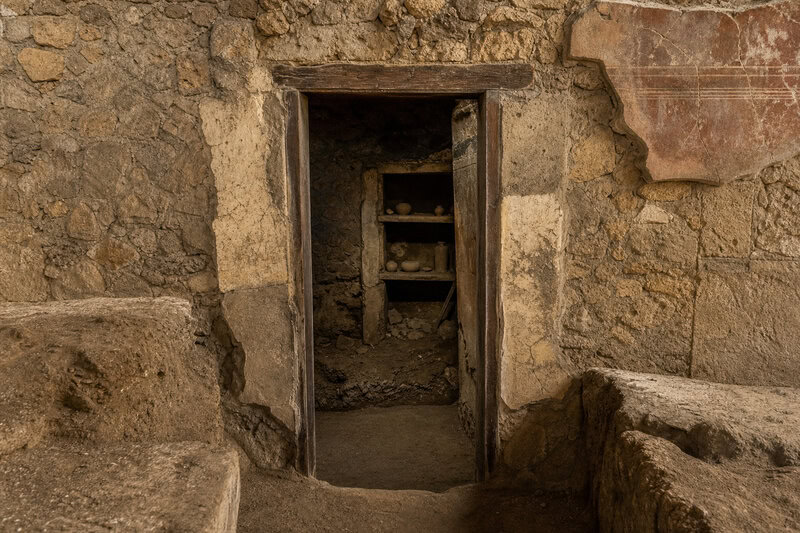
The sealed, undisturbed state of the closet is the central mystery. Had the family died inside the house during the eruption, excavators would expect to find human remains nearby. Their absence suggests the inhabitants may have got out — at least initially. The ashfall that began in the eruption was survivable for hours; many Pompeians did flee, streaming toward the harbour or along the roads that led north and south. It is possible the mistress of the house was among them, pushing through panicked crowds with whatever she could carry, intending to return once the mountain quieted.
She never came back. Whether she died on a road outside the city, or in the pyroclastic surges that swept down Vesuvius’s flanks and killed those who had sheltered or delayed, or whether she survived the eruption and found herself exiled permanently from a city that no longer existed — none of that is recoverable from the evidence. What is recoverable is what she left behind: the perfume she thought she would retrieve, the coins she expected to spend, the pots she planned to cook with again.
This find joins a long series of Pompeii discoveries — rings left on windowsills, doors bolted from inside, food still in ovens — that collectively sketch a city mid-decision, caught between the hope of return and the reality of annihilation. Each one is a small argument that the people of Pompeii, to the very end, expected to survive.
Why Dated Coins Matter: Pinning Down the Eruption
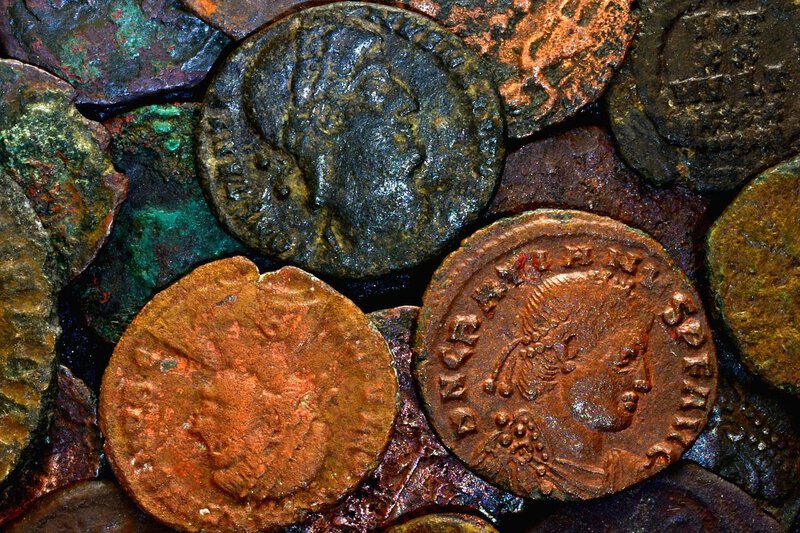
The bronze coins carry an additional layer of value beyond their economic story. Numismatic evidence from Pompeii has played a central role in one of ancient history’s most consequential dating debates. For much of the modern period, scholars accepted the date of August 24th, 79 CE, derived from a letter by Pliny the Younger, who witnessed the eruption from across the Bay of Naples and described it in correspondence written decades later. But coin finds from Pompeii — including coins minted after the traditionally accepted date — have contributed to a growing body of evidence suggesting the eruption may have occurred in October or November rather than August. Autumnal pomegranates and walnuts found preserved in carbonised form, the warm clothing on some victims, and a coin bearing an inscription dateable to after August all point in the same direction.
The thirty-eight bronze coins from this closet have not been reported to overturn that debate, but they sit within a tradition of numismatic evidence from the site that continues to refine historians’ understanding of the city’s final weeks. Even ordinary household savings, mundane by any ancient standard, contribute data points to questions that matter enormously for the historical record.
Why an Ordinary Closet Is Extraordinary Evidence
Pompeii’s most famous discoveries — the plaster body casts, the grand forum, the elaborate frescoes — are spectacular precisely because they are exceptional. The closet on the Via dell’Abbondanza is valuable for the opposite reason: it is completely ordinary. Cosmetics, coins, cooking equipment, pantry mice. These are the materials of an unremarkable life, and unremarkable lives are the ones history most consistently fails to preserve.
For archaeologists, sealed domestic contexts like this one are rarer and more informative than grand public spaces. The objects inside were chosen by the people who lived with them, not arranged for display or ceremony — which makes them honest evidence of actual priorities, actual habits, actual economies. As CBS News reported, everyday details like these often tell us more about Roman life than grander finds can.
Pompeii continues to be excavated under the ongoing Great Pompeii Project, and finds like this one — small, human-scaled, achingly specific — are the reason the site remains one of the most important windows into ancient Roman everyday life anywhere in the world. The mistress of the house, whose name no document preserved, whose face no portrait survives to show us, left behind thirty-eight coins and a bottle of perfume and a pantry full of mice. It turns out that is more than enough to know her by.