
The road stretches west into the Hunan mountains at dusk, and a Taoist priest moves along it in near-silence, leading a procession that should not, by any logic of the living, be moving at all. Behind him, in the failing light, come the bodies — arms extended, torsos rigid, advancing in a slow and synchronized hop that no living person would recognize as a human gait. What the terrified farmers watching from the tree line could not have known was that what they were seeing was equal parts funeral rite and optical illusion. What they told their children, and their children’s children, was something else entirely.
What Is a Jiangshi?
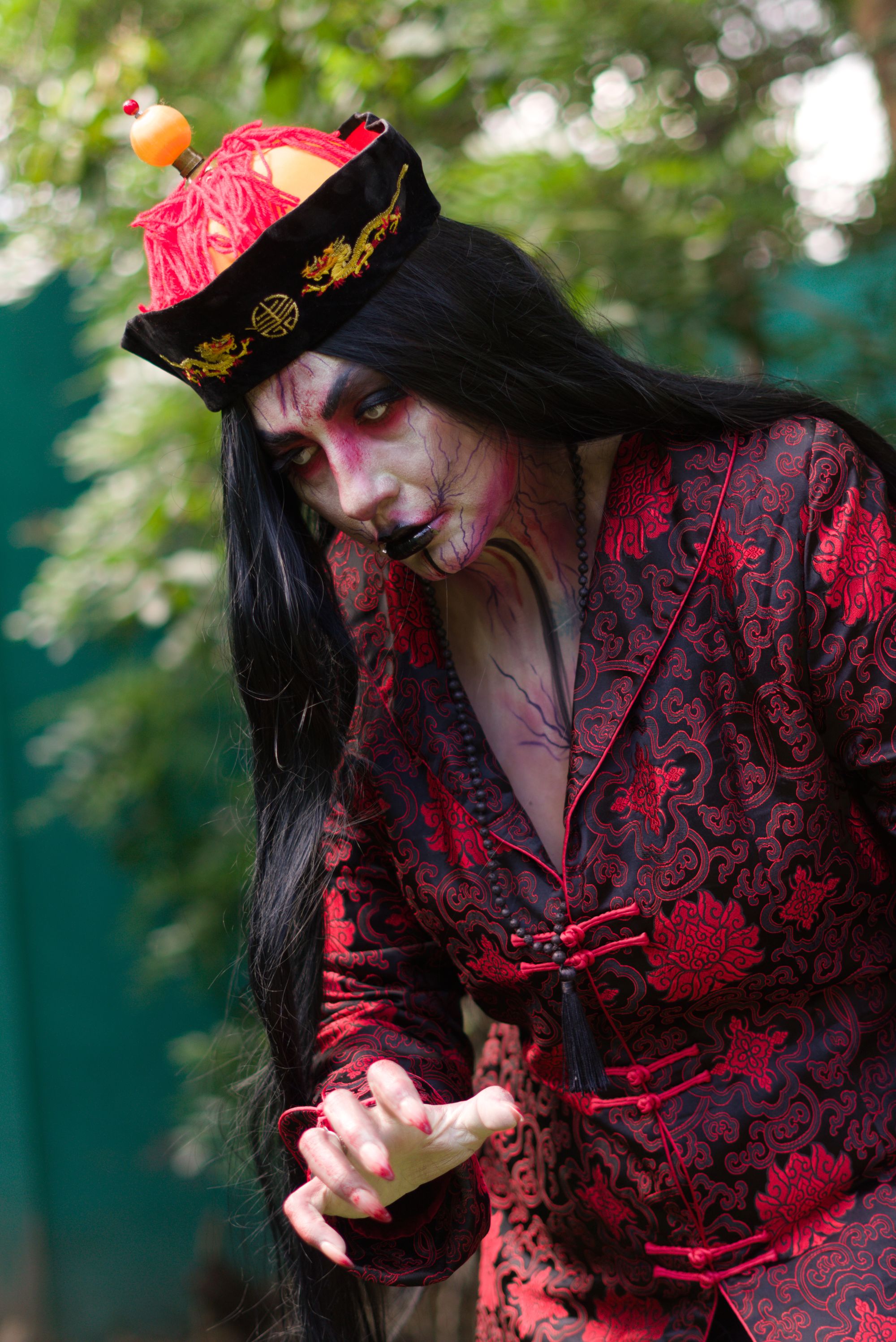
The word jiangshi (僵屍, also written 殭屍) translates with brutal simplicity: stiff corpse. It is a type of reanimated corpse in Chinese legend and folklore that occupies an uneasy position between the two great Western archetypes of the undead without being either. It drinks life — specifically the vital qi-force of living bodies — like a vampire. It is mindless, relentless, and decaying like a zombie. But it is neither Dracula nor a Walking Dead extra. It is something older and stranger than both, and its physical signature alone tells you why.
The jiangshi cannot bend. Rigor mortis has locked its joints, which means it cannot walk in any conventional sense. Instead, it advances by hopping — arms thrust straight out in front, body held stiffly upright, lurching forward in short, rhythmic bounds. This is precisely where the label “Chinese hopping vampire” originates, and why the image is so instantly recognizable once you have encountered it. There is something almost absurd about it until you imagine meeting one on a mountain path in darkness, and then the absurdity evaporates completely.
The supernatural portfolio attributed to the jiangshi across different regional accounts is formidable. Descriptions throughout Chinese folklore credit the creature with superhuman strength, extraordinarily acute hearing, and a physical durability that makes conventional resistance futile. Some accounts push further, describing a jiangshi capable of vanishing and reappearing elsewhere — a quality suggesting that its earliest conception was as much a spirit as a corporeal threat. It is also sometimes called a hungry ghost, a term that connects it to broader Chinese cosmological belief around the restless, malevolent dead: souls who cannot eat, cannot rest, and cannot move on, condemned to wander in a state of perpetual, ravenous incompletion.
The Funeral Practice That Made the Legend

To understand where the jiangshi comes from, you have to understand one of the most distinctive and little-discussed funeral customs in Chinese history: xiangxi ganshi, or corpse-walking. In an era long before refrigerated transport or reliable roads, enormous numbers of Chinese laborers — miners, construction workers, canal diggers — died far from home, in provinces that were not theirs, among people who did not know their ancestors’ names. This mattered enormously. In a society built on ancestor veneration, dying away from your family’s burial ground was not merely sad. It was cosmologically catastrophic. A soul improperly buried, unconnected to its lineage and homeland, could not rest. It would become exactly the kind of restless, dangerous, hungry thing that the jiangshi represents.
The solution was as practical as it was eerie: hire a Taoist priest — known in this context as a corpse driver — to bring the body home. These specialists were paid to transport the bodies of those who died far from home back to their ancestral villages, sometimes over distances of hundreds of miles through mountain terrain that made wheeled transport impossible. The mechanics of how they accomplished this are where the legend crystallizes.
A body in rigor mortis cannot be laid flat on a narrow mountain track — the terrain does not permit a stretcher, the path does not allow a cart. The practical solution was to lash the corpse upright to a long bamboo pole, with carriers taking the ends across their shoulders. As the men walked, the pole flexed. The bound body bobbed and lurched in a characteristic up-down motion. At night, with torchlight catching only the moving shape and not the pole or the carriers, witnesses saw what appeared to be a rigid figure hopping steadily along the road under its own power, arms extended outward where they were tied to the pole’s crosspiece. The priests who performed this work cultivated deliberate secrecy around the rite — their livelihoods depended on their mystique — which meant that terrified eyewitness accounts spread through villages long before any explanation did.
The practice was especially associated with Hunan province and other regions of western China, whose rugged geography made them both a major source of itinerant labor and a logistical nightmare for the return of the dead. The combination of difficult terrain, high rates of laborers dying away from home, and the cultural imperative to return them created exactly the conditions in which corpse-walking thrived — and in which the stories it generated could take on a life of their own.
Roots in Ancient Chinese Belief

The jiangshi did not begin with the Qing dynasty, though it crystallized there. Written references to stiff, reanimated corpses appear in texts reaching back to the Han dynasty, and the creature evolved steadily through the ghost literature of the Tang and Song periods before taking the specific form most people recognize today. What remained consistent across those centuries was the cosmological framework underneath.
Chinese belief held that the human soul is not a single unified thing but a compound of two distinct components. The hun is the spiritual soul, the part that ascends and eventually finds its proper rest in the afterlife. The po is the corporeal soul, the animating force bound to the physical body. In normal circumstances, death allows both to separate cleanly. But violent death, improper burial, or dying far from home could trap the po soul inside the rotting body, unable to leave, unable to rest, and increasingly desperate and dangerous as it deteriorated. That trapped po soul — still animated, still hungry — is the jiangshi.
The creature’s specific weaknesses reflect this cosmological origin with remarkable precision. Glutinous rice, peach-wood swords, mirrors, and yellow paper talismans inscribed with Taoist incantations are among the tools traditionally used against a jiangshi — not arbitrary monster-movie inventions, but objects and substances with deep roots in actual Chinese ritual practice. Glutinous rice was associated with yang energy and vitality. Peach wood carried protective power in Taoist cosmology. Each defense reflects a real belief system rather than a screenwriter’s convenience.
Regional variation was considerable. Southern Chinese jiangshi traditions often emphasize the vampire-like qualities — the draining of qi, the predatory hunt for life-force — while northern accounts lean more heavily on the image of a mindless, physically dangerous corpse. Some traditions describe a jiangshi that grows more powerful with age, eventually shedding its rotting flesh for a coat of white fur as it transitions from a corporeal threat into a fully spiritual entity. The creature was never a single fixed thing. It was a shape that different communities pressed their specific fears into.
How Fear Spread — and Why It Served a Purpose

The combination of real processions moving through real darkness, the cultural weight of improper burial, and the rapid print culture of the Qing dynasty allowed jiangshi stories to move across provinces with extraordinary speed. The fear had genuine administrative consequences: Qing dynasty records include accounts of officials being compelled to investigate widespread public panic over jiangshi reports, suggesting that the legend had moved well beyond campfire-story status into something that demanded governmental response.
But the jiangshi myth was not purely destructive. It served a social function with real structural importance. In a society where ancestor veneration was not merely a religious preference but a civic and moral duty, the idea of a family member’s corpse becoming a predatory monster — specifically because it was not brought home and buried properly — was a story with teeth. It weaponized guilt alongside fear. The legend enforced the obligation to retrieve the dead, to pay the corpse drivers, to make the impossible journey across mountain provinces, because the alternative was not just sadness but cosmological catastrophe. The jiangshi was a pressure system as much as a ghost story, and it kept communities bound to one another across vast distances by making the consequences of severance genuinely terrifying.
From Terror to Theater — and Back Again

The pivot into popular culture came sharply in 1985, when the Hong Kong film Mr. Vampire (殭屍先生) gave the jiangshi to global audiences in a form that was simultaneously faithful to the lore and unabashedly theatrical. The hopping, the outstretched arms, the yellow talisman pressed to the forehead — all of it was there, but reframed as comedy-horror, with the creature’s rigid locomotion playing for physical comedy even as the cosmological framework underneath remained largely intact. The film launched a genre that dominated Hong Kong studios through the late 1980s, producing dozens of jiangshi films that retain a devoted following today.
The tonal shift was real, and so was the cost. What had been a source of genuine provincial dread — a fear rooted in grief, guilt, and the terror of dying unmoored from home — became camp. The creature survived the transformation regardless. In the 2010s and into the 2020s, jiangshi surged into international visibility through anime, manga, video games, and streaming productions, reaching Western audiences who encountered the term for the first time and immediately wanted to know where it had come from. That curiosity is warranted. The history is richer than any single film or franchise suggests.
That renewed interest also exposes a gap that popular adaptations rarely fill: the jiangshi’s emotional core. Western reimaginings tend to keep the hops and the talisman and discard the rest — the hun and po framework, the corpse-walking rites, the specific grief about dying in a stranger’s province. What gets lost in translation is the part that makes the creature genuinely distinctive rather than merely visually unusual.
The Stiff Corpse That Never Really Died

Return to that road in the Hunan dusk. The procession moving through the fading light was, in all likelihood, not supernatural at all. It was probably exhausted men carrying bamboo poles, performing difficult and thankless labor for a grieving family that could not bear to leave a son or husband buried in a stranger’s earth. The fear was real. The corpse was real. The hops were real, in their way. But what the witnesses saw and what they reported were two very different things, and the gap between them is where the jiangshi lives.
The corpse-walking practice was still reported in remote parts of western Hunan into the early twentieth century, which means the custom and the legend it generated overlapped with the modern world for longer than most people realize. The creature and the rite that made it were contemporaries with automobiles and telegraphs, still moving through mountain passes that modernity had not yet reached.
In some of the oldest accounts, the jiangshi does not hunt because it is malevolent. It hops endlessly, blindly, arms outstretched, because it is searching. It wants to get back. Every story it appears in, every film and manga and game, carries that original impulse underneath the horror: this is a creature that died wrong, in the wrong place, and has been trying ever since to reach somewhere that will finally let it rest.
That is not a monster story. That is a story about longing. And longing, if it goes on long enough, turns out to be one of the most frightening things there is.


