
Somewhere in a museum gallery, a visitor squints at the cartouche of ancient Egypt’s most audacious ruler and whispers something that sounds vaguely like “hat-shep-SOOT” — close, but not quite right, and not for lack of trying. Three and a half millennia after she wore the double crown, Hatshepsut is still mispronounced by nearly everyone who encounters her name for the first time. The fix is simpler than most people expect — and more interesting than a dry phonetics lesson deserves to be.
The Short Answer: How to Pronounce Hatshepsut
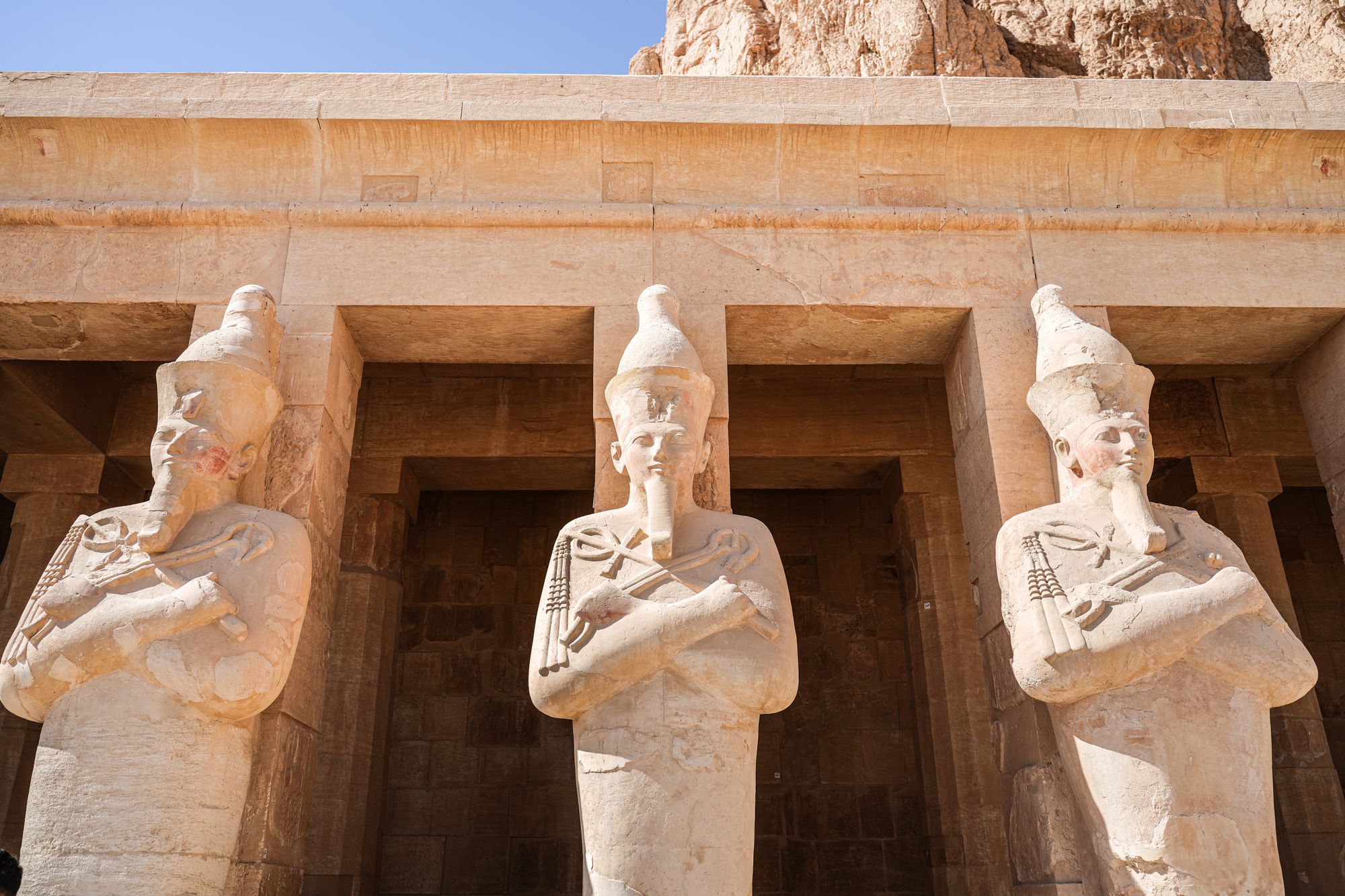
The name breaks into three syllables: hat — shep — sut. The stress falls firmly on the middle syllable, giving you hat-SHEP-sut. The first syllable rhymes with either “hat” (common in American English, IPA /hæt/) or “haht” (common in British English, IPA /hɑːt/). The final syllable uses the short rounded vowel of “foot” or “put” — not the drawn-out vowel of “food” or “soot.” Both Wiktionary and Forvo record the full IPA as either /hætˈʃɛpsʊt/ or /hɑːtˈʃɛpsʊt/ depending on dialect. Both are correct.
Syllable by Syllable: A Detailed Breakdown
Syllable 1 — “Hat” or “Haht”
This is where American and British English diverge, and both paths are phonetically legitimate. American speakers naturally reach for /hæt/, the flat, short vowel identical to the everyday word “hat.” British speakers tend toward /hɑːt/, the broader, deeper vowel heard in “father.” Wiktionary documents both variants explicitly. What matters most is that you choose one and commit to it cleanly — drifting between the two within a single utterance sounds less like a dialect choice and more like hesitation.
Syllable 2 — “SHEP” (Stressed)
Two things are critical here: the consonant and the stress. The “sh” at the opening of this syllable is the single smooth sound /ʃ/ — identical to the consonant in “shoe” or “shell” — not two separate sounds. Voicing the S and H independently produces a fractured “hat-s-hep-sut” that no phonetic source supports. Fuse them completely.
More importantly, this syllable carries the primary stress. The IPA stress marker (ˈ) sits before /ʃɛps/ in every recorded transcription. Misplacing the stress is the single most recognizable Hatshepsut error: “HAT-shep-sut” sounds flat and uncertain; “hat-shep-SOOT” buries the weight at the wrong end entirely. Landing hard on “SHEP” is what distinguishes a speaker who knows this name from one making a polite guess.
Syllable 3 — “Sut” (Rhymes With “Put”)
The spelling tempts speakers toward a long “oo” — the vowel in “moon” or “soot.” The IPA says otherwise. Both Wikipedia’s transcription (/hɑːtˈʃɛpsʊt/) and Forvo’s recorded British English pronunciation use the symbol ʊ, the short rounded vowel of “foot” and “put.” The practical test: say “put,” then say “sut” with the identical vowel. Stretching it into a long “soot” adds a theatrical quality that no phonetic source supports.
Common Mispronunciations and Why They Happen
- “HAT-shep-sut” — Stress lands on the wrong syllable. The name sounds like a brand name rather than an ancient Egyptian title.
- “hat-shep-SOOT” — Double error: stress is displaced to the final syllable, and the vowel is lengthened incorrectly.
- “hat-S-hep-sut” — The “sh” digraph is split into two separate sounds. This happens when readers process letters individually rather than as a phonetic unit.
- “HATE-shep-sut” — The first vowel is lengthened into a long “a,” as though the word ended in a silent “e.”
All four errors share a common cause: treating the written letters as a direct guide to sound rather than consulting phonetic sources. English spelling is an unreliable narrator, and ancient Egyptian proper nouns transliterated into English are especially prone to misleading visual cues.
How to Practice Until It Sticks

Say it out loud, slowly, and exaggerated. Silent reading or internal mouthing skips the physical rehearsal your mouth actually needs. Start with deliberate, exaggerated slowness — “HAT… SHEP… SUT” — pausing between each syllable. That exaggeration forces your articulators into the correct positions before speed is introduced. Once the slow version feels effortless, gradually close the gaps until the three syllables flow as a single uninterrupted word.
Listen to a recorded human voice. IPA symbols are precise but abstract. Forvo hosts a recorded pronunciation of Hatshepsut by a British English speaker, which provides a genuine human model rather than a synthesized rendering. Listen twice before repeating: once to absorb the overall shape, once to isolate the stressed middle syllable and the short final vowel. Then play it at full speed and speak in the half-second silence after the recording ends — a technique called shadowing that closes the gap between what you hear and what your mouth produces far faster than passive listening alone.
Hear the name in real spoken context. YouGlish’s UK English pronunciation tool surfaces video clips in which real speakers use the word in natural sentences, so you can hear how the name behaves when it is not being performed for a phonetics exercise. Hearing it embedded in documentary narration or academic lectures reinforces the stress pattern and vowel quality in a way that isolated repetition cannot replicate.
Who Was Hatshepsut? (Context Makes the Name Stick)

Pronunciation lives longer in memory when it belongs to a real story, and Hatshepsut has one of the most compelling stories of the ancient world. She was the sixth pharaoh of Egypt’s Eighteenth Dynasty, reigning from approximately 1505 to 1458 BC. She began as regent for her young stepson Thutmose III and then assumed full pharaonic power herself — wearing the double crown and the ceremonial false beard traditionally reserved for male rulers.
Under her reign, Egypt undertook ambitious building projects, including the mortuary temple at Deir el-Bahari, and sent trade expeditions to the land of Punt. Her memory was considered so threatening by later successors that they attempted to chisel her image and cartouches from monuments decades after her death — and still failed to erase her. Wikipedia’s article on Hatshepsut describes her as one of ancient Egypt’s most powerful female rulers. Knowing that this name belongs to a specific, formidable, historically documented human being gives your brain a reason to remember the correct pronunciation rather than settling for a convenient approximation.
Which Variant Should You Use?
If you are a British English speaker or you are speaking in a formal British academic context, /hɑːtˈʃɛpsʊt/ is the natural choice. If you are an American English speaker, /hætˈʃɛpsʊt/ is equally defensible and documented. The stress pattern — always on “SHEP” — and the short final vowel — always /ʊ/, rhyming with “put” — are non-negotiable in both variants. Everything else is dialect.
Consistency signals authority. A speaker who delivers “hɑːt-SHEP-sut” or “hæt-SHEP-sut” with complete confidence sounds like someone who has done their homework. A speaker who trails off on the final syllable as though asking a question, or who alternates randomly between stress patterns, sounds like someone still working it out. Commit to your variant, land the stress on “SHEP” every time, and the name of Egypt’s most powerful female pharaoh will eventually roll off your tongue as naturally as it deserves.
Three thousand five hundred years is a long time for a name to survive. It deserves to be said correctly — and now you can.


