
17. Hitler’s territorial ambitions begin in the Rhineland
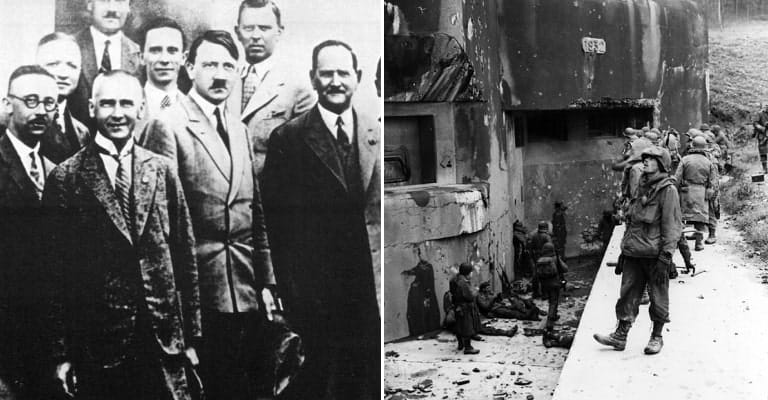
The Versailles Treaty had established that German military forces and fortifications would not be allowed in the area known as the Rhineland, and that Allied forces would not withdraw from the region until 1935. In fact the Allies withdrew their occupation troops in 1929 (British) and 1930 (French) as part of the negotiations over the German payment of war reparations. The year before the French withdrew they began construction of the series of forts along the French frontier which became known as the Maginot Line. For the first half of the 1930s French, Italian, British, and Soviet diplomats maneuvered over various means of containing Germany within its borders, and in 1935 France and the Soviet Union signed a treaty of alliance, which the Germans declared was a violation of the Versailles Treaty.
By 1935 the German economy was again faltering, with inflation and food shortages driving up prices and German support of the Nazi regime falling, especially in the larger cities. Hitler, desirous of a prestige building foreign policy victory, decided to remilitarize the Rhineland in January 1936. Although Goering counseled against the decision and even attempted to persuade Mussolini to dissuade the Fuhrer, the German army marched into the Rhineland beginning in March, 1936, supported by Luftwaffe aircraft. Hitler followed his coup by offering to return Germany to the League of Nations and offered a treaty of non-aggression to the French. France, which was most threatened by the German move, did nothing to oppose it militarily, and Hitler knew from that point that his other territorial desires in Europe were feasible.


