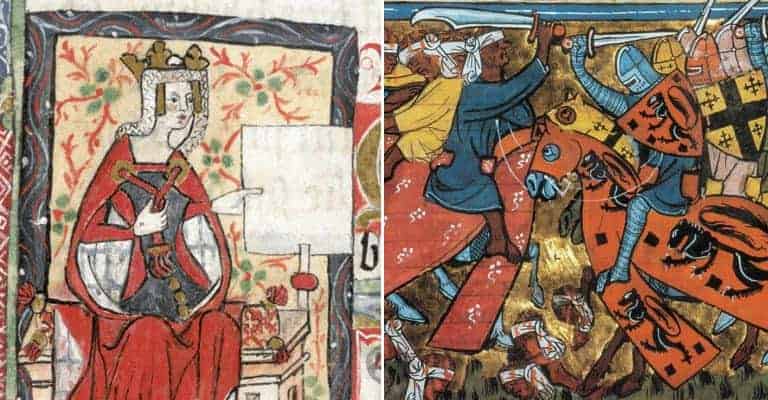

Catherine of Valois
The slight and delicate appearance of Catherine of Valois (1401-37), daughter of Charles VI of France (known insensitively as ‘Charles the Mad’ because of his mental illness), belied her destiny to change temporarily the fortunes of the Hundred Years’ War. Aged 19, she was married to King Henry V of England, a burly, battle-hardened warrior, who had been making the life of France miserable as he sought to become the first man to rule both kingdoms. So great was Henry’s new empire that he was called ‘king of all the world’ by the hyperbolic French chronicler, Enguerrand de Monstrelet.
But just 2 years later, the ‘king of all the world’ ingloriously died of dysentery during the Siege of Meaux. Catherine had by this time borne Henry a son, who became King Henry VI of England and France aged just 9 months. With the Hundred Years’ War still raging, the last thing England needed was the instability of a baby-king. As daughter of Charles VI, English lords viewed Catherine with suspicion, cruelly denying her much of a role in her son’s upbringing. However, as widowed mother to the king she wielded significant influence, and many feared her next matrimonial alliance.
Such was her potential world-changing influence that legislation was hastily drawn up in 1427 forbidding marriage to a queen without royal consent (or that of his advisers, given the age of Henry VI), under the penalty of her husband losing all his lands and possessions. Undeterred, Catherine began a sexual relationship with her servant, Owen ap Maredudd ap Tudor, a Welsh courtier, around 1430. This was scandalous: Wales had long been suppressed by England, and Welshmen were not even allowed to own property. They were married in secret, by contrast to the pomp and ceremony of her first marriage.
Marrying Tudor brought Catherine no benefit: he was not a rich man, had no possessions by law, and no political influence, and the marriage remained a secret until her death. The alliance, therefore, must have been for the purer reason of love, which reveals her strength of personality. Catherine could have allowed herself to be married off to a powerful lord chosen for political reasons by the king’s advisers, but she retained her right to choose a mate, and thought nothing of lowering herself by marrying beneath her station. Her grandson was Henry VII, founder of the Tudor dynasty.


