
The President and the Automobile
The first President to ride in an automobile while serving in office was William McKinley in 1901. The car was the famous Stanley Steamer and McKinley rode in it for only a short distance. One would expect that his successor, Theodore Roosevelt, would have embraced the automobile but he did not, believing that his riding in one would detract from his image. Roosevelt rode around Washington in a horse-drawn carriage with his Secret Service detail following on foot until they obtained a steam-powered car of their own in 1907. Thus the Secret Service had a car before the President did. The Secret Service used a White Steamer.
The White House Stables were closed by William Howard Taft and he became the first President to use automobiles as his main form of local transportation. Taft purchased a pair of Pierce-Arrow cars, which in their day were known for their luxurious appointments. He also added to his fleet a White Steam Car and a Baker Electric car. The Baker was seldom used other than by Mrs. Taft, and Taft gradually grew to prefer the White Steam Car, despite it being less luxurious than the Pierce-Arrows. A nudge from Taft to his driver would lead to the driver releasing a burst of steam which Taft found useful when he wanted to avoid being photographed or hounded by the press.
Woodrow Wilson rode to his inauguration in a horse-drawn carriage but once in office he developed a taste for the Pierce Arrow’s and bought three new models for the White House fleet. He grew to be so fond of them that upon leaving office he bought one from the government for his personal use. He did not drive himself though. The first President to have a driver’s license upon entering office was Warren Harding, who also holds the distinction of being the first President to be driven in an automobile to his inauguration. The car was a Packard Twin-Six. The Secret Service by then had established a strict rule keeping the President from driving an automobile.
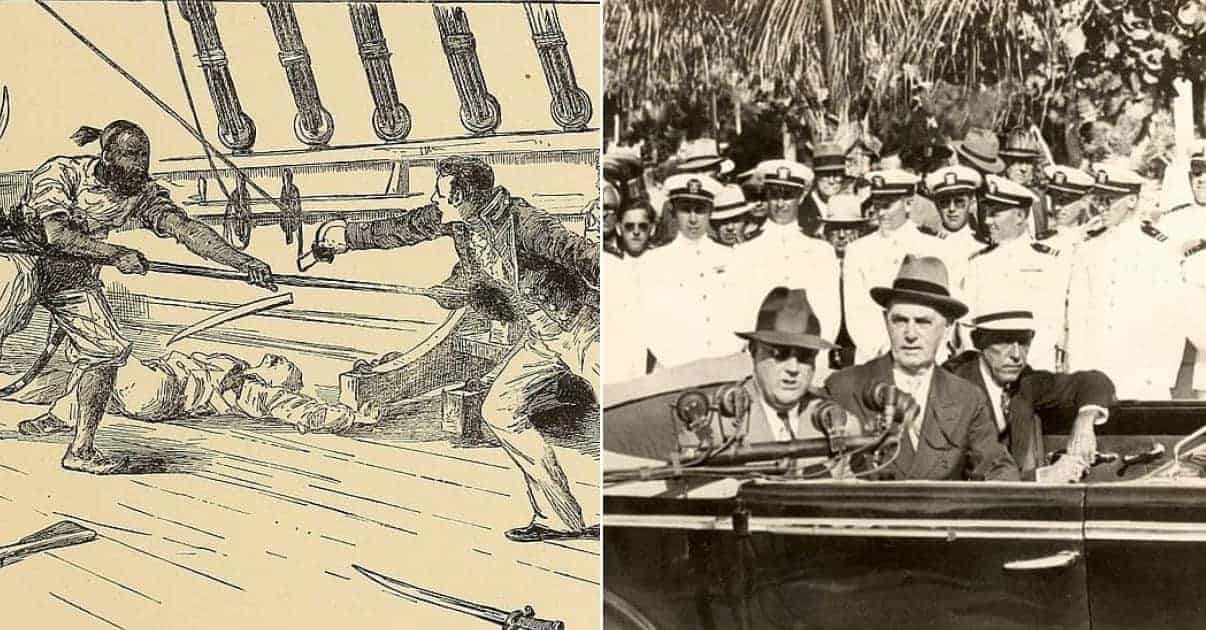
FDR didn’t give a fig for the Secret Service regulations, purchasing while in office a Ford Phaeton which he had modified to be operated through hand controls. Roosevelt took delivery of the vehicle in 1936 and drove it when he pleased, usually at Hyde Park and occasionally at Shangri La when it became a Presidential retreat in 1942. It is now known as Camp David. Roosevelt added several cars to the Presidential fleet, including a 1933 Cadillac, a 1936 Packard, and a 1939 Lincoln Convertible which was called the Sunshine Special. The Special was the first automobile built to the specifications of the Secret Service and accompanied FDR to his wartime conferences in Casablanca, Teheran, and Yalta.
In 1950 Harry Truman’s White House leased a fleet of 10 Lincolns. Truman himself directed these vehicles, which were specially built versions of the Lincoln Cosmopolitan, to be obtained from that company rather than the competing Cadillac, which was built by General Motors. Nine were solid-body vehicles and the tenth was a convertible. It was one of these vehicles in which the President took the wheel while returning to Washington from Charlottesville, Virginia. Reporters in the following press car claimed that the President went well over the speed limit and an indignant Truman responded that he never exceeded the pace set by the escorting police vehicles. It was the first time a President had been reported for speeding in an automobile.


