
Bayer Was a Member of a Conglomerate That Produced the Chemicals Used in the Holocaust
Bayer is a German pharmaceutical company historically best known as the makers of Aspirin, more recently for making wonder drugs such as Levitra, and to soccer fans, as the initial sponsors of Bundesliga club Bayer Leverkusen. It also owns household brands such as Claritin, Coppertone, and Dr. Scholl’s. For most of its history, Bayer was a run-of-the-mill business – except for when it was part of IG Farben, the chemical conglomerate that produced the poisonous chemicals used in the Holocaust.
Bayer was founded in 1863 as an independent company, but in 1925, it became part of IG Farben – a union of major chemical companies, modeling themselves after Standard Oil in a quest to form a monopoly. The new conglomerate would go on to participate in numerous atrocities during the Nazi era. It began even before the war broke out, when the Western Powers handed Czechoslovakia to Hitler in a failed attempt at appeasement. IG Farben worked closely with the Nazis and Germany’s military, instructing them which chemical factories should be seized and delivered to IG Farben. They did the same during the invasion of Poland.
When the Holocaust began, German authorities grew concerned that their initial means of killing Jews and other “undesirables”, such as mass shootings or gassing in vans, were slow, inefficient, and took too much of a psychological toll on the murderers. IG Farben owned a cyanide-based insecticide, Zyklon-B, and proposed its use in sealed rooms as a speedy means of disposing of large numbers of people. Tests proved them right, and thus were born the gas chambers of the extermination camps. IG Farben would go on to produce and supply the Nazis with all the Zyklon-B gas canisters they needed to kill millions of men, women, and children.
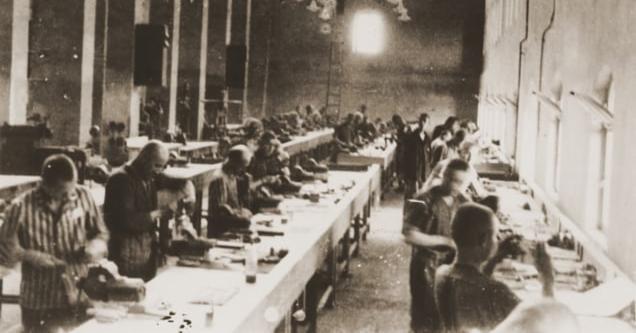
And because that was not fiendish enough, the chemical conglomerate also set up factories in those death camps, such as Auschwitz-Birkenau, where it made use of slave labor on a massive scale. IG Farben’s slave workers were forced to toil in horrific conditions and were frequently starved, beaten, mistreated, with the ever present threat of murder hanging over their heads.
After the war, 24 IG Farben directors were indicted for war crimes, and 13 of them were convicted and sentenced to prison terms of varying lengths. However, all of them were released early, and most were restored to their directorships or resumed their business careers. Some of them even went on to win civilian medals from the West German government. The conglomerate itself survived the war, until it was split into its original constituent companies. Bayer returned to being an independent company in 1952. It is not the only surviving member of IG Farben: the chemical giant BASF, which posted sales of more than € 70 billion in 2015, was also once a part of the Nazi conglomerate.


