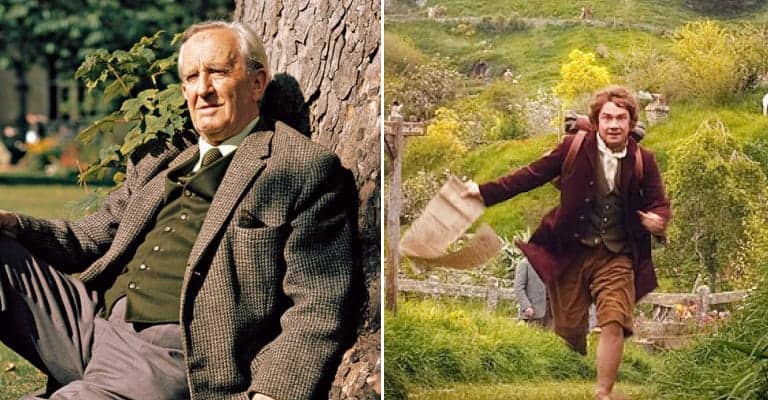
1. Oxford is still a mecca for Tolkien fans

Given that Tolkien spent most of his life in Oxford, a city dominated by an ancient university which is not keen on change, it is unsurprising that so many sites dear to Tolkien remain. If you’re a Tolkien fan, visiting the city thus must be top of your bucket list. His undergraduate college, Exeter, is over 700 years old, and has a monument to him in its chapel. You can also visit the colleges that he taught at – Pembroke (once home to Dr Johnson, and where Tolkien wrote The Hobbit), and Merton (the oldest college at nearly 800 years old).
Tolkien’s homes at 20 Northmoor Road and 76 Sandfield Road have commemorative plaques, but can only be viewed from the street. The Bodleian Library, where he conducted his phenomenal research and formulated ideas for Middle Earth, is however open to the public. Most appealingly, The Eagle and Child pub is still open for business, and you can sit in The Rabbit Room where The Inklings used to meet and view some relics. But moreover, the city was a place so dear to Tolkien that he chose to be buried there, and his grave is frequented by Middle Earth-pilgrims.
Where did we find this stuff? Here are our sources:
Carpenter, Humphrey. Tolkien: A Biography. Houghton Mifflin Company, 1977.
“The Somme and the ‘animal horror’ that inspired J.R.R. Tolkien” The One Ring, October 5th, 2013.
MacEacheran, Mike. “In Alpine villages, Hobbits lurk”. BBC Travel.
Tolkien, Christopher. The Complete History of Middle-Earth. London: Harper Collins, 2002.
Tolkien, J.R.R. The Hobbit, or, There and Back Again. Thorndike Press, 2003.
Tolkien, J.R.R. The Lord of the Rings. 3 vols. London: Harper Collins, 2003.


